

Custom Alabaster Lighting occupies a distinctive place in contemporary interior design.It is neither simply a decorative lamp nor merely another natural-stone accessory. When light passes through genuine alabaster, the mineral body itself becomes part of the lighting system: veins appear more clearly, warmer areas become translucent, darker inclusions remain visible, and every fixture develops an individual character.
For homeowners, interior designers, architects, hospitality buyers and developers in the United States and Europe, this combination of natural material and architectural light is one of the main reasons custom alabaster lighting continues to work across residential, hospitality and commercial interiors. A carefully specified alabaster table lamp can create an intimate layer of light beside a sofa; an alabaster pendant light can become a focal point above a dining table or kitchen island; and a sculptural alabaster floor lamp can provide both illumination and architectural presence in a hotel lobby, living room or private suite.
At Liora Light, our approach is to treat alabaster lighting as an interior-design material rather than a generic lamp category. Selected designs can be customized for project requirements, while typical order preparation for standard configurations is approximately one week before shipment. Project-specific modifications should always be confirmed before ordering because dimensions, electrical requirements, finishes and structural changes can affect production.
What Is Alabaster Lighting?
Alabaster lighting refers to lighting fixtures in which alabaster is used as a visible shade, diffuser, panel, block or sculptural element. The most recognizable characteristic is its ability to transmit and soften light while retaining the natural veining of stone.
From a geological perspective, the term alabaster is commonly associated with a compact, fine-grained variety of gypsum. The U.S. Geological Survey describes alabaster in this context as a fine-grained form of gypsum. That natural mineral structure helps explain why every piece can show differences in color, clouding and veining. You can read the geological reference from the U.S. Geological Survey.
This variation is important when choosing a natural alabaster lamp. Two pieces made to the same dimensions may not look identical when illuminated. One section may have soft cream-colored clouds; another may show amber, brown or gray mineral lines. In mass-produced plastic or printed glass, these variations would be treated as inconsistencies. In genuine natural stone lighting, they are part of the material itself.
For this reason, good custom alabaster lighting design begins with understanding the stone rather than attempting to force every piece to look perfectly uniform.
Why Alabaster Works So Well as a Lighting Material
1. It Diffuses Light Instead of Simply Hiding the Bulb
A conventional opaque metal shade controls light mainly by blocking and redirecting it. Clear glass exposes the light source more directly. Alabaster behaves differently. Depending on stone thickness and mineral composition, light enters the stone and creates a softly luminous surface.
The result is especially effective in spaces where atmosphere matters: bedrooms, living rooms, dining rooms, boutique hotels, restaurants, reception areas and private clubs. The fixture can remain visually interesting when switched off, then change character when illuminated.
2. Every Alabaster Fixture Has Natural Variation
Natural veining means an alabaster fixture does not look completely industrial or repetitive. This is particularly valuable in high-end interiors, where excessive uniformity can make materials appear artificial.
However, buyers should understand the distinction between variation and quality control. Natural veining is expected. Poor alignment, unsuitable stone selection, weak structural support or inconsistent electrical assembly are manufacturing issues. A well-made alabaster light should preserve natural variation while maintaining controlled dimensions, stable construction and reliable electrical performance.
3. It Works With Both Classical and Contemporary Interiors
Alabaster has enough visual depth for traditional interiors but is neutral enough for contemporary architecture. When paired with aged brass, it can feel warm and classical. Combined with dark bronze or black metal, the same stone can become much more architectural. With minimal polished metalwork and simple geometry, alabaster can also fit modern, quiet-luxury and minimalist interiors.
That versatility is one reason custom alabaster lighting is useful for designers working across different room types rather than only one decorative style.
Three Ways to Use Alabaster Lighting in an Interior
The correct fixture type depends less on what looks impressive in isolation and more on what the room actually needs. Table lamps, pendants and floor lamps each solve a different lighting problem.
Fixture TypeBest ApplicationsPrimary Design RoleAlabaster Table LampBedside tables, consoles, desks, side tablesLocalized ambient and decorative lightAlabaster Pendant LightDining rooms, kitchen islands, stairwells, barsSuspended focal lightingAlabaster Floor LampLiving rooms, hotel suites, lobbies, loungesArchitectural vertical accent and ambient light
Alabaster Table Lamps: Small Scale, Strong Material Presence
An alabaster table lamp is often the easiest way to introduce natural stone lighting into an interior because it does not require the visual scale of a chandelier or floor-to-ceiling installation. Yet a successful table lamp still needs careful proportion.
The relationship between the stone shade and the base matters. If the base is too visually heavy, the alabaster can appear secondary. If it is too delicate, the lamp may feel unstable. This is why geometric designs work particularly well: the base provides visual structure while the translucent stone becomes the illuminated focal point.
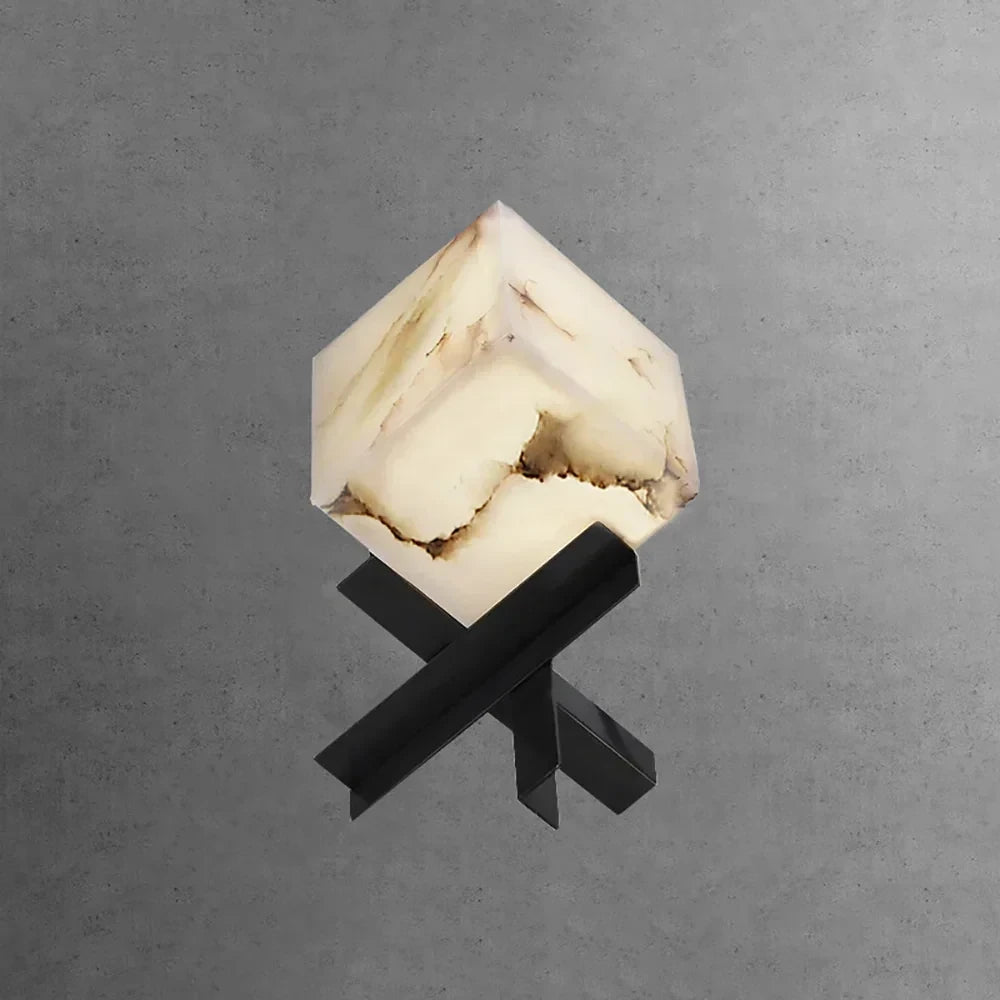
The Alabaster Crossed-Base Table Lamp uses a luminous geometric alabaster form above a contrasting architectural base.
The Alabaster Crossed-Base Table Lamp demonstrates this relationship clearly. The stone is not treated as a thin decorative attachment. Instead, the luminous alabaster volume forms the visual center of the design, while the crossed base creates a strong structural counterpoint.
For residential projects, this type of luxury alabaster table lamp works well on a console, side table or large bedside surface. In hospitality design, it can be specified for reception areas, suites and lounge spaces where the fixture needs to remain decorative during both daytime and evening use.
Alabaster Pendant Lights: Designing Light in the Vertical Space
Pendant lighting introduces another design consideration: suspension. A pendant is not only an object; it occupies a vertical relationship between ceiling, fixture and furniture.
For that reason, selecting an alabaster pendant light should involve more than choosing diameter. Designers should consider ceiling height, suspension length, visual sight lines, spacing between multiple pendants and the relationship between the bottom of the fixture and the surface below it.
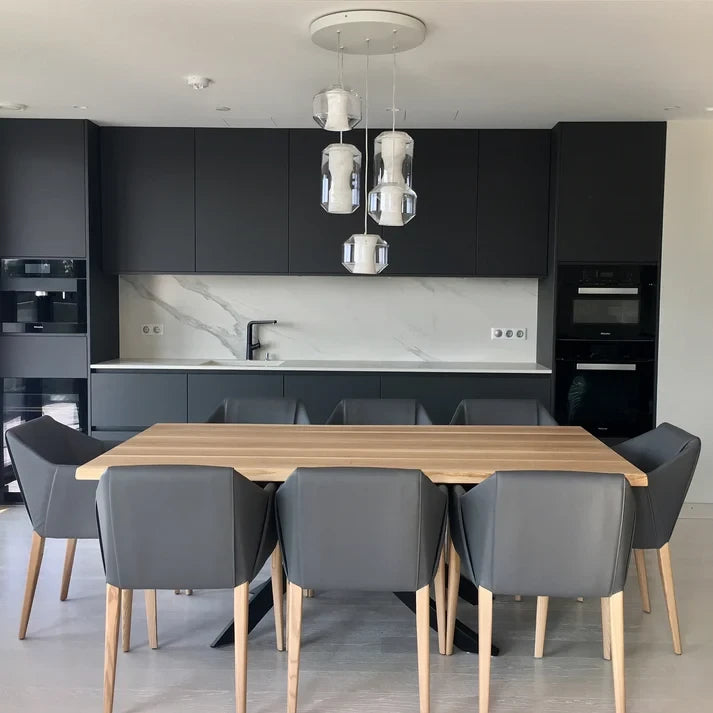
The Alabaster Inner Core Pendant combines a translucent outer form with an illuminated alabaster center.
The Alabaster Inner Core Pendant takes a layered approach. Instead of using stone as the external shell alone, the alabaster becomes an illuminated inner core. The clear outer body allows the natural stone to remain visible while adding another layer of depth around it.
This type of construction is particularly useful in contemporary interiors because the fixture feels visually lighter than a fully opaque stone pendant. A single pendant can work over a bedside table or compact dining area, while multiple units can create a rhythm over a kitchen island, bar counter or long table.
For custom projects, suspension length is especially important. A pendant installed in a standard residential dining room and the same design installed in a double-height lobby may require very different cable lengths and visual spacing. These details should therefore be determined from the room dimensions rather than selected only from product photography.
Alabaster Floor Lamps as Architectural Objects
A large alabaster floor lamp has a different role from a conventional reading lamp. When natural stone is stacked vertically, the fixture begins to function like an illuminated architectural object.
This approach works particularly well in interiors that need visual height without introducing another piece of furniture. A sculptural floor lamp can occupy a corner, frame a seating group, soften a dark wall or establish a vertical focal point in an entrance or hotel suite.
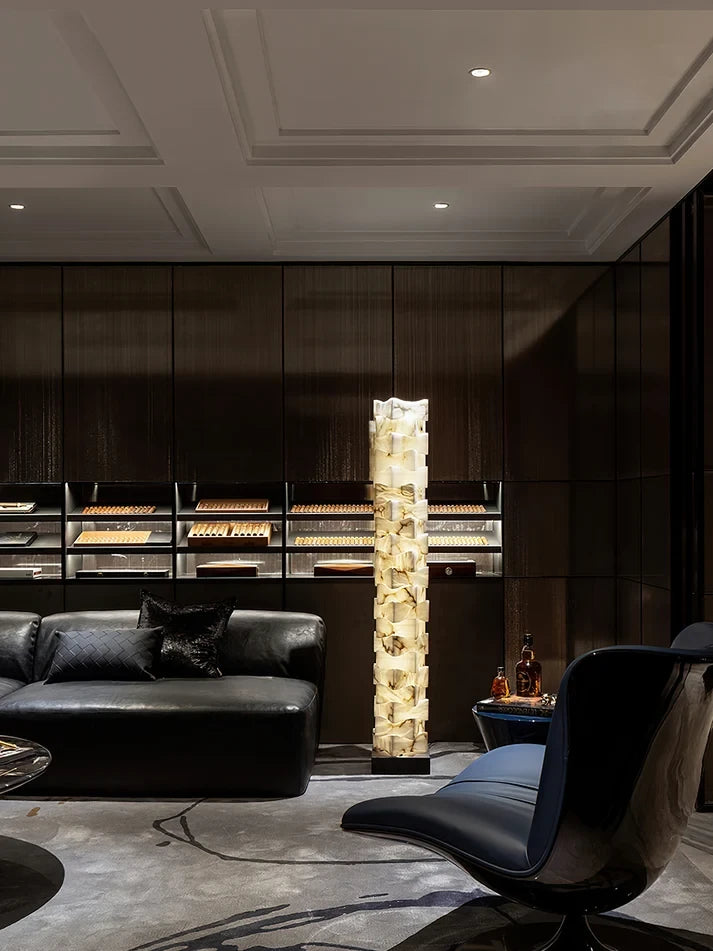
The Stacked Alabaster Geometry Floor Lamp uses vertically arranged natural stone forms to create an architectural column of light.
The Stacked Alabaster Geometry Floor Lamp shows how alabaster can move beyond the traditional idea of a lampshade. Individual stone elements are arranged vertically so that the entire fixture becomes part sculpture, part ambient light source.
This is particularly effective in luxury living rooms, executive offices, hotel lobbies and larger hospitality environments. Unlike a small decorative object, a tall alabaster floor lamp needs to be considered in relation to wall height, nearby seating, circulation routes and viewing distance.
What Can Be Customized in Alabaster Lighting?
The value of custom alabaster lighting is not simply the ability to change a color. Proper project customization considers the relationship between the fixture, the room and the electrical environment in which it will be installed.
Depending on the design and technical feasibility, customization may involve:
- Fixture dimensions: adjusting the scale to suit furniture, ceiling height or architectural proportions.
- Metal finishes: coordinating brass, bronze, black or other finishes with surrounding hardware and furniture.
- Suspension length: particularly important for pendant lights and high ceilings.
- Stone selection: managing the general visual direction of alabaster while accepting natural variation.
- Light source: selecting appropriate LED or replaceable lamp configurations depending on the fixture.
- Color temperature: where the lighting system permits, warmer or more neutral output can be specified for the intended environment.
- Electrical configuration: plug, driver and voltage requirements should be matched to the destination market and specific product.
Because alabaster is natural stone, customization should not be interpreted as digital replication. A client can establish an aesthetic direction, dimensions and technical requirements, but the natural veins should remain part of the final piece.
Why Color Temperature Matters With Natural Alabaster
Lighting temperature significantly affects how alabaster is perceived. Warm light tends to emphasize cream, amber and honey tones within the stone. More neutral light may make pale sections appear cleaner and can increase visible contrast between different mineral patterns.
There is no universally correct color temperature for every alabaster fixture. The decision should be coordinated with surrounding materials. Walnut, dark oak, brushed brass and warm fabrics often work naturally with warmer illumination, while pale stone, neutral walls and contemporary metalwork may support a more neutral appearance.
For energy-conscious residential and commercial projects, modern LED technology is particularly relevant. The U.S. Department of Energy provides additional information on the energy-efficiency and service-life advantages of LED lighting compared with traditional incandescent technology.
Custom Alabaster Lighting for US Projects
When specifying custom lighting for the United States, aesthetic design and electrical suitability should be treated as separate parts of the specification.
A beautiful fixture is not automatically suitable for every electrical installation. Buyers working on residential, hospitality or commercial projects should confirm voltage, light-source type, driver configuration, mounting conditions and any certification requirements applicable to their project.
For reference, UL Solutions identifies standards such as UL 1598 for luminaires and UL 153 for portable electric luminaires. More information is available through UL Solutions' lighting standards overview.
This does not mean every decorative fixture automatically carries every certification. Certification requirements vary by product, configuration and project. Architects, contractors and commercial buyers should establish the required compliance standard before finalizing a custom order.
Custom Alabaster Lighting for European Projects
European projects require the same discipline. Rather than assuming that a fixture made for one destination can simply be installed in another, electrical configuration should be confirmed for the specific country and installation.
European Union requirements concerning light sources, energy efficiency and separate control gear are documented by the European Commission. For professional projects, electrical and regulatory requirements should be reviewed before production, particularly when a custom fixture involves changes to the light source, driver or electrical components.
For designers, this is an important distinction: custom alabaster lighting should combine aesthetic customization with technical specification. Changing the size of the stone or length of a pendant is only one part of the process.
How to Specify Custom Alabaster Lighting
A clear specification reduces unnecessary revisions and helps preserve the original design intent. Before ordering a custom alabaster fixture, it is useful to prepare the following information.
1. Define the Installation Location
State whether the fixture will be used in a living room, bedroom, dining room, hotel lobby, restaurant, suite, reception area or another environment. The application often determines the appropriate scale and lighting output.
2. Provide Room and Ceiling Dimensions
For pendants and larger floor lamps, overall room dimensions matter. A fixture that appears substantial in a product photograph may feel smaller in a large double-height space, while an oversized design can dominate a compact room.
3. Confirm the Destination Country
Country information is necessary because electrical requirements, plug formats and installation practices vary between markets.
4. Identify the Desired Finish
Metal finishes should normally coordinate with other permanent details in the space, including door hardware, furniture, bathroom fixtures or architectural metalwork.
5. Determine Whether the Project Requires a Standard or Custom Size
Standard dimensions are usually the simplest route. Custom dimensions become useful when a lighting fixture must align with a specific table, wall opening, ceiling condition or furniture layout.
6. Allow for Natural Stone Variation
This point should be agreed upon before production. Genuine alabaster should not be expected to display identical vein patterns from one piece to another. Natural variation is one of the main reasons designers choose the material.
Preparation Time and Project Planning
For Liora Light's standard configurations, the typical order preparation time is approximately one week before shipment. This makes selected alabaster lighting practical not only for private residential purchases but also for projects working within defined installation schedules.
Custom specifications should still be discussed before the order is finalized. A change in dimensions, structure, finish or electrical configuration may require additional confirmation. For project buyers, the safest approach is to finalize specifications before scheduling installation teams or site work.
In other words, preparation time and transit time should be treated separately. The approximately one-week preparation period refers to preparing the order before shipment; international delivery time depends on destination and shipping method.
How to Choose Between a Table Lamp, Pendant and Floor Lamp
If the goal is flexible decorative lighting without permanent ceiling work, start with an alabaster table lamp. It is suitable for smaller areas and can easily be repositioned when furniture changes.
If the goal is to define a dining table, island, bedside zone or vertical architectural axis, an alabaster pendant light is usually more appropriate. Pendant lighting should be planned together with ceiling height and furniture placement.
If the room needs a large decorative object that also provides ambient illumination, a sculptural alabaster floor lamp can create more architectural impact. Floor lamps are particularly effective where the room needs vertical visual interest but another chandelier would make the ceiling feel crowded.
Many sophisticated interiors use more than one lighting layer. An alabaster pendant may provide the primary decorative focal point, while table and floor lamps create lower-level light around seating zones. This layered approach usually produces a more comfortable evening environment than relying on a single ceiling fixture.
Explore the Alabaster Lighting Collection
If you are comparing different forms of natural stone lighting, explore the Liora Light Alabaster Lighting Collection. The collection allows you to compare different proportions, materials and fixture types before deciding whether a standard design or customized solution is more appropriate.
Three useful starting points are:
- Alabaster Crossed-Base Table Lamp — suitable for consoles, side tables, desks and bedside applications.
- Alabaster Inner Core Pendant — suitable for dining spaces, kitchen islands, bedside suspension and grouped installations.
- Stacked Alabaster Geometry Floor Lamp — suitable for larger living rooms, hospitality environments and spaces requiring a strong vertical focal point.
Frequently Asked Questions About Custom Alabaster Lighting
Is alabaster suitable for luxury residential lighting?
Yes. Alabaster is particularly effective in luxury residential interiors because it combines natural stone texture with soft transmitted light. It can be used in table lamps, pendant lights, wall lighting, chandeliers and sculptural floor lamps, depending on the design.
Is every alabaster lamp identical?
No. Genuine natural alabaster contains variations in veining, transparency, color and mineral pattern. Even fixtures produced to the same dimensions can show visible differences. These variations are part of the natural character of the material rather than a printed surface effect.
Can alabaster lighting be customized?
Yes. Liora Light supports custom alabaster lighting for suitable designs and projects. Depending on technical feasibility, customization can involve dimensions, metal finishes, suspension lengths and electrical specifications. Specific requirements should be confirmed before production.
How long does it take to prepare an order?
Typical preparation time for standard configurations is approximately one week before shipment. Customized designs may require additional specification confirmation before production, so project buyers should confirm timing when placing the order.
Can alabaster lighting be supplied for US and European projects?
Yes. Liora Light serves customers in both the United States and Europe. Because electrical requirements differ by country and installation, buyers should provide the destination market when discussing a project so that appropriate specifications can be reviewed.
What type of light works best with alabaster?
LED lighting is widely used with contemporary alabaster fixtures because it offers high energy efficiency and allows designers to control light output and color temperature. The exact light source should still be selected according to the fixture's design, stone thickness and intended atmosphere.
Is natural veining a defect?
No. Veining, clouding and tonal variation are normal characteristics of natural alabaster. A completely uniform pattern should not be expected from genuine stone. What should remain controlled are the fixture dimensions, construction, assembly and electrical components.
Where should an alabaster floor lamp be placed?
A large alabaster floor lamp works especially well beside a seating group, against a darker wall, in a hotel lobby, near an entrance or in an otherwise unused architectural corner. The surrounding space should be large enough for the fixture to be viewed as a complete vertical composition.
Can several alabaster pendant lights be installed together?
Yes. Repeated pendant installations can work particularly well above kitchen islands, long dining tables, bar counters and stairwells. For grouped installations, spacing, hanging height and cable length should be planned as a complete composition rather than treating every pendant independently.
How should I choose the right custom alabaster light?
Start with the function of the room, then consider fixture scale, installation height, desired metal finish, electrical requirements and the amount of visual impact you want the lighting to create. For custom projects, providing room dimensions, destination country and reference images can make specification much more precise.
Final Thoughts: Treat Alabaster as Both Stone and Light
The most successful alabaster lighting does not treat the material as decoration added to an ordinary lamp. The stone itself should be considered part of the lighting experience.
Its natural veins affect appearance. Its thickness influences transmission. The color temperature changes how the mineral tones are perceived. The size of the fixture determines whether it becomes a quiet accent or an architectural focal point. And in custom projects, electrical requirements are just as important as proportions and finishes.
For US and European interiors seeking something warmer than glass, more tactile than acrylic and less visually cold than an all-metal fixture, custom alabaster lighting offers a strong balance of natural material, sculptural form and atmospheric illumination.
Whether the project begins with an alabaster table lamp, an alabaster pendant light or a sculptural alabaster floor lamp, the right starting point is the same: define the space first, then specify the lighting around it.
Explore more alabaster lighting by Liora Light to compare designs for residential, hospitality and interior-design projects.